5 Whys Root Cause Analysis: Steps, Template & Example
The Toyota technique for finding what actually caused a problem, not just its symptom.


The Five Whys is a root cause analysis technique from Toyota: keep asking why a problem happened, typically five times, until you reach a systemic cause rather than a symptom. It is fast, needs no statistical training, and forces one causal chain to its end so the failure doesn't recur.
The 5 Whys is a root cause analysis technique where you ask "why" repeatedly, typically five times, until you identify the underlying systemic cause instead of just symptoms.
Your equipment fails on Tuesday. The maintenance team fixes it. It fails again on Friday. Three weeks later, same failure. This cycle continues because everyone treats the symptom, the broken part, instead of asking why it broke.
The 5 Whys breaks this pattern. Developed by Sakichi Toyoda at Toyota in the 1930s, it's the standard root cause analysis method across manufacturing, healthcare, and software development. Systematic questioning strips away symptoms to expose the process gaps, training deficiencies, and procedural weaknesses that let problems persist. Applied correctly, it takes under an hour.
What Is the 5 Whys Root Cause Analysis Method?
The 5 Whys is a questioning technique: ask "why" a problem occurred, ask "why" that condition existed, and keep going until you hit something fixable at a systemic level, not just a symptom.
The technique is deceptively simple. Start with a specific problem, ask why it happened, then take that answer and ask why again. Keep going until asking "why" one more time would just be splitting hairs. That usually takes about five iterations, hence the name, but effective analyses sometimes stop at three and others run to eight.
Why the 5 Whys Works When Other Methods Don't
Organizations often spend weeks on elaborate root cause analyses using fault trees, fishbone diagrams, and statistical process control charts, only to implement solutions that don't stick. The 5 Whys succeeds where these often fail, for three reasons.
It's fast: a thorough analysis takes under an hour, while problems are still fresh and evidence hasn't been cleaned up. It's accessible: the operator who saw the problem doesn't need statistical training, just honest answers about what they observed. And it forces a single causal chain all the way down, instead of the analysis-paralysis that comes from mapping every possible contributing factor at once. You can always circle back and explore alternatives if your first path doesn't hold up.

The 5 Whys Checklist: What You Need Before You Start
Most failed 5 Whys sessions fail before they even begin because people skip the setup. You need four things in place before you ask the first question:
- A specific problem statement. "Quality issues in Department B" won't work. "Thirty-seven units failed final inspection on December 18th due to incomplete welds" will. Specificity disciplines your thinking and keeps the analysis focused.
- The right people. That means at least one person who directly observed or experienced the problem, someone who understands the process well enough to spot abnormal conditions, and a facilitator who can keep the questions moving forward. Three to five people is ideal. More than that and you'll spend more time managing the discussion than conducting the analysis.
- Location at the gemba. Conduct the analysis close to where the problem occurred. This principle, which Toyota calls gemba, matters more than most people realize. Conference rooms encourage abstract thinking. The shop floor, the customer service desk, or the server room keeps everyone grounded in physical reality. You can point at things. You can test hypotheses on the spot.
- Commitment to honest answers. If the real reason your new hires keep making mistakes is that your training program is inadequate, you need people willing to say that out loud. If your preventive maintenance schedule was designed fifteen years ago and never updated, someone needs to acknowledge it. The Five Whys only works if people tell the truth about what they see.
5 Whys Template: How to Complete the Analysis
The mechanics are straightforward, but execution requires more care than most people expect.
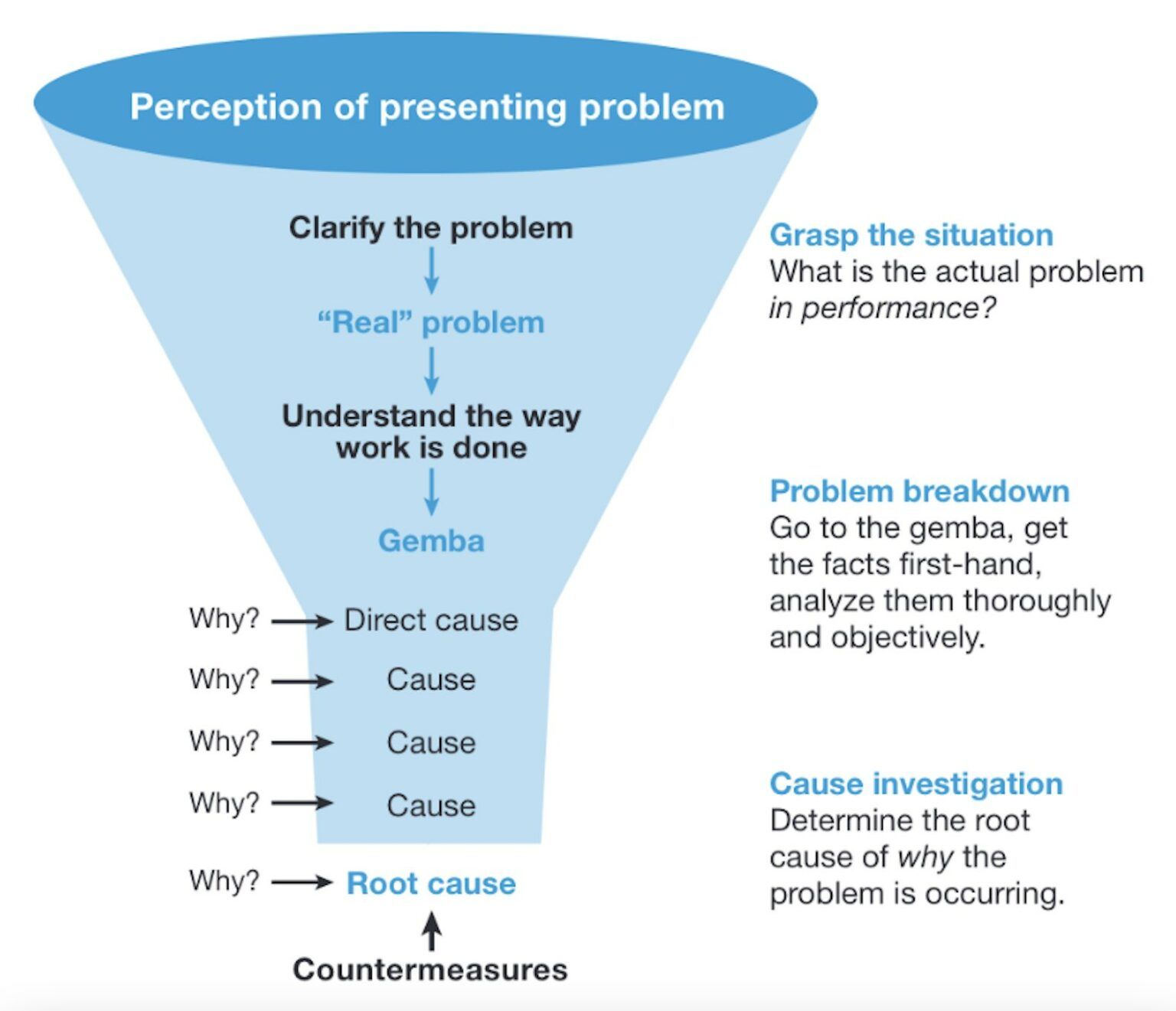 Five Whys funnel diagram from problem to root cause
Use this simple template to run the analysis, filling in each line with a verified fact, not a guess:
- Problem: What happened, where, when, and how you know it. ("Line 3 produced 847 units against a target of 1,000 during first shift on Dec 20th," not "production was slow.")
- Why 1: Why did this specific problem occur?
- Why 2: Why did that condition exist?
- Why 3–5 (as needed): Keep asking why of the previous answer.
- Root cause: The systemic gap you can actually fix.
- Corrective action: The specific fix, owner, and deadline.
Each answer should be something you can verify: a physical observation, sensor data, a log, or direct testimony, not speculation. "Probably the operator forgot" isn't an answer; "the feed line was clogged, confirmed by checking oil flow" is. Stop once you reach a process failure or systemic gap you can fix with a clear corrective action, revising a maintenance procedure or adding a training step, rather than "operator error" or "equipment failure," which are symptoms, not causes.
The number of whys is a guideline, not a rule. Some analyses reach the root cause in three questions; others need eight. What matters is reaching something you can actually fix.
When to Use the 5 Whys (and When Not To)
The 5 Whys is most effective for problems with one dominant causal chain: equipment failures, quality defects, process bottlenecks, safety incidents, and customer complaints. Ask it here and you'll typically reach the fix quickly.
It's less effective for complex problems with multiple simultaneous, interacting causes, like a major product recall spanning design, materials, and distribution, where fishbone or fault tree analysis lets you map several pathways at once. It also struggles with deep organizational or cultural roots: if people don't report problems for fear of retaliation, asking "why" five times might surface that fact, but fixing it needs change management, not a questioning technique.
The Toyota Origin of the 5 Whys
Sakichi Toyoda developed the 5 Whys in the 1930s as part of what became the Toyota Production System, insisting that problems were symptoms of deeper issues that could be identified and eliminated rather than accepted as inevitable. His son Kiichiro Toyoda and engineer Taiichi Ohno refined it in the decades after World War II, formalizing the practice of observing problems firsthand at the gemba and asking why until reaching something systemic.
The method spread beyond automotive manufacturing in the 1970s-80s as Western companies studied Toyota's success, though often without the cultural foundation that made it work: it only survives in an environment where people feel safe identifying systemic problems and management is committed to fixing them, not one that shoots the messenger.
5 Whys Best Practices
- Focus on processes, not people. If your analysis points to an individual's mistake, keep going: why didn't training or a verification step catch it? A well-designed process assumes people will make mistakes and builds in safeguards.
- Verify every answer. The 5 Whys fails when it becomes brainstorming instead of investigation. Each answer needs evidence, a log, a measurement, a witness, not a guess.
- Stay on one causal chain at a time. Resist branching into every contributing factor at once; follow the most likely path to the end first, then circle back if it doesn't hold up.
- Keep questions neutral. "Why wasn't the pressure checked?" surfaces procedural gaps; "why did the operator forget?" just points toward blame.
- Know when to stop. You're done when the answer is something fixable through a procedural, training, or design change, not a philosophical statement about culture or budget.
Common 5 Whys Mistakes
The most frequent mistake is stopping at a symptom: a part fails, the team replaces it, logs "component failure," and moves on without asking why it failed. Close behind is accepting "human error" as the root cause, when the real question is why that error was possible and why existing safeguards didn't catch it. Teams also rush through the questions when they're uncomfortable, quickly blaming an operator instead of investigating, or branch off into several causal chains at once and never follow any of them to a concrete root cause. Each of these produces an analysis that looks complete but changes nothing.
5 Whys Example: The Original Toyota Case
Here's the classic example from Taiichi Ohno, one of the architects of the Toyota Production System, documented in his book "Toyota Production System: Beyond Large-Scale Production" (1988, p. 17).
The problem: A machine stopped functioning on the factory floor.
Why #1: "Why did the machine stop?"
Answer: There was an overload and the fuse blew.
Why #2: "Why was there an overload?"
Answer: The bearing was not sufficiently lubricated.
Why #3: "Why was it not lubricated sufficiently?"
Answer: The lubrication pump was not pumping sufficiently.
Why #4: "Why was it not pumping sufficiently?"
Answer: The shaft of the pump was worn and rattling.
Why #5: "Why was the shaft worn out?"
Answer: There was no strainer attached and metal scrap got in.
Root cause: No strainer in the lubrication system allowing debris contamination.
Corrective action: Install a strainer in the lubrication system to prevent metal scrap from entering the pump.
This example demonstrates the fundamental questioning pattern. Modern Five Whys analyses typically include more detailed evidence documentation at each step (inspection reports, sensor data, maintenance logs), but the core approach of following a single causal chain to reach a systemic issue remains unchanged. Notice how the analysis moved from a symptom (blown fuse) through intermediate causes (overload, insufficient lubrication, worn shaft) to arrive at a fixable process gap (missing strainer).
Implementing the 5 Whys in Your Organization
Start with a pilot program, one department or one type of problem, rather than a company-wide rollout, and train a small group thoroughly rather than everyone superficially. Expect the first few analyses to feel awkward: people will want to skip to solutions or struggle to phrase neutral questions. That's normal and improves with practice. After each analysis, debrief on the process itself (did we gather evidence or speculate? follow one chain or branch off?), and track whether corrective actions actually get completed, since root cause analysis without follow-through is worse than no analysis at all. Give it six months before judging whether it's working; a shortfall by then is usually an implementation problem, not a flaw in the method.
Measuring Whether the 5 Whys Is Working
Four metrics tell the story: problem recurrence (do issues that used to recur monthly or quarterly stop appearing?), cycle time from problem to implemented fix (this should shrink with practice), quality of corrective actions (systemic fixes, not "be more careful" reminders), and staff engagement (are frontline staff bringing problems forward and suggesting causes on their own?).
5 Whys Limitations
The method assumes a roughly linear cause-and-effect chain, so it struggles with modern failures that result from several systems interacting at once (software, sensors, mechanical wear) rather than one dominant path. It also depends entirely on the honesty and knowledge of whoever answers: people who don't know will speculate, and people worried about blame will stop at a superficial answer. It's prone to confirmation bias if the team already suspects a cause, and it won't tell you which of twenty recurring problems to tackle first, that needs a separate prioritization framework based on risk, cost, or frequency. None of this makes the method useless, but it does mean recognizing when a problem needs a different or additional approach.
Prove Your Fixes Are Actually Working
FlowFuse connects your PLCs, SCADA, and quality systems so you can track whether a corrective action is holding, in real time, not just assume it is.
Frequently Asked Questions
About the Author
Sumit Shinde
Technical Writer
Sumit Shinde is a Technical Writer at FlowFuse specializing in industrial automation and manufacturing. In the past three years, he has built industrial applications and authored more than 100 technical articles covering industrial connectivity, unified data architecture, production metrics, and quality management for modern manufacturing.
Like what you're reading?
Add FlowFuse as a preferred sourceOn the page that opens, check the box next to flowfuse.com to see more of our articles in your Google Search results.
Related Articles:
- Your Company Already Picked an AI Agent. Now It Can Run Your Operations.
- Run at Rate: Proving Production Capacity Before Launch
- What Is SCADA? Supervisory Control and Data Acquisition
- Automotive Traceability: How Production Data Gets Tied to a Part
- Layered Process Audit (LPA): A Practical Guide + Checklist